


What Are Sand Fleas and Do They Bite?
In This Article
- Which Animals Get Called Sand Fleas?
- What Do Sand Fleas Look Like?
- Mole Crabs
- Do Sand Fleas Bite?
- Look-Alikes: Which Ones Bite?
- What's Biting You at the Beach?
- Are Sand Fleas Dangerous?
- Where Do Sand Fleas Live?
- Sand Fleas in North Carolina
- Sand Fleas vs. Household Fleas
- Can They Come Home With You?
- How to Prevent Bites
- How to Treat Bites
- When to Call a Pro
- Sand Flea FAQs
The sand fleas on North Carolina beaches do not bite. The name usually refers to beach hoppers and mole crabs, two small crustaceans that eat seaweed and plankton, not blood. When you leave the beach with itchy red bumps, the most likely cause is a biting midge, the tiny fly locals call a no-see-um. The one "sand flea" that truly burrows into skin, the chigoe flea, lives in the tropics and is not found in the United States.
Which Pests Get Called Sand Fleas?
"Sand flea" is a nickname, not a species, and people use it for at least four unrelated animals. Knowing which one you're dealing with tells you whether you need to worry.
- Beach hoppers (beach amphipods): Small crustaceans that jump around washed-up seaweed. Also called sand hoppers or beach fleas.
- Mole crabs: Small crustaceans that burrow in wet sand where waves break. Surf anglers call them sand fleas and use them for bait.
- Biting midges (no-see-ums): Tiny flies whose females bite. Also called sand flies or sand gnats.
- Chigoe fleas (Tunga penetrans): True fleas that burrow into skin, found in tropical regions.
A CDC manual on flea control adds a fifth possibility. In northern states, the "sand fleas" people complain about are usually cat or dog fleas tied to stray animals.
What Do Sand Fleas Look Like?
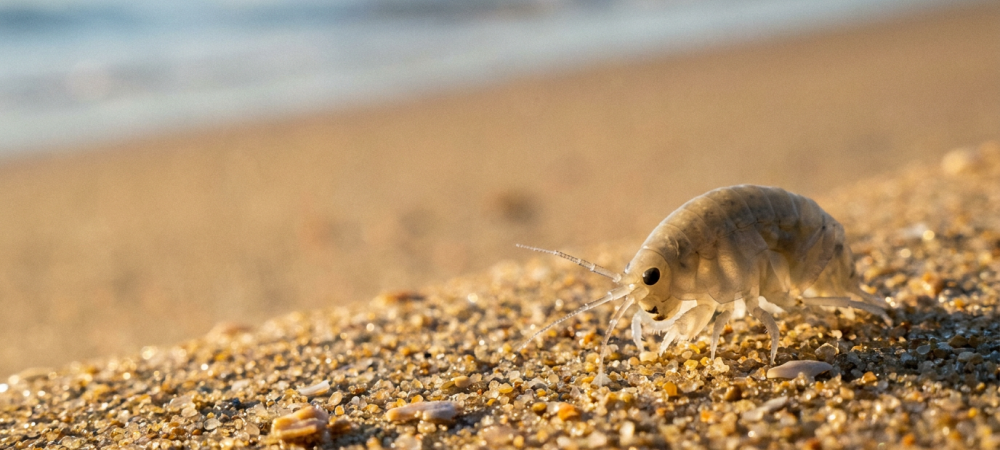
Beach hoppers, the most common sand fleas on Carolina beaches, look like tiny shrimp with curved, segmented bodies and several pairs of legs. Their gray, brown, or tan coloring helps them blend into the sand, and some are nearly translucent.
Common identifying characteristics of beach hoppers include:
- Body shape: Curved, segmented, and flattened from side to side
- Color: Gray, brown, tan, or nearly translucent
- Antennae: Long, and in some species nearly as long as the body
- Legs: Several pairs beneath the body
- Movement: Quick jumps when disturbed
- Location: Damp sand, especially under seaweed and beach debris
Beach hoppers are crustaceans, not insects. True fleas are insects with six legs. Their jumping earned beach hoppers the "flea" nickname.
Sand Flea Size
Beach hoppers on the Atlantic coast range from under half an inch to about 1 inch long. According to Britannica, the common sand flea is about 0.4 inches long, while the Atlantic sandhopper, found from New England to the Gulf of Mexico, can reach 1 inch. Small hoppers are hard to spot against the sand, and the larger ones are easy to see when they jump.
Mole Crabs: The Sand Fleas Surf Anglers Use
Mole crabs are the other animal Carolina beachgoers call sand fleas, and they don't bite either. The Atlantic mole crab is a small, egg-shaped, gray-tan crustacean about 1 inch long or less, according to the National Park Service. Mole crabs burrow backward into the wet sand where waves wash up and strain food from the water with feathery antennae. Kids catch them in the surf, and anglers use them as bait for pompano and drum.
Do Sand Fleas Bite?
Beach hoppers and mole crabs, called sand fleas on North Carolina beaches, do not bite people. Beach hoppers eat decaying seaweed and other organic debris, and mole crabs filter plankton from the surf. Neither feeds on blood, so neither has any reason to seek out people or pets. In a 1988 UNC Sea Grant interview, NC State entomologist Charles Apperson said beachgoers who blame biting sand fleas are most likely being bitten by regular fleas, no-see-ums, or mosquitoes.
Myth: Sand fleas bite and lay eggs under your skin.
Fact: The sand fleas on Carolina beaches are harmless crustaceans. The only "sand flea" that burrows into skin is the chigoe flea, a tropical insect not found in the U.S. If you're itching after a beach day, a no-see-um is the likely culprit.
Sand Flea Look-Alikes: Which Ones Bite?
The animals people mistake for sand fleas that do bite are no-see-ums, mosquitoes, ordinary fleas, and the tropical chigoe flea. Use this table to tell them apart.
| Pest | What to Look For | Do They Bite? |
|---|---|---|
| Beach hoppers (amphipods) | Gray to tan, shrimp-like, up to 1 inch; hop near seaweed at night | No |
| Mole crabs | Egg-shaped, gray, about 1 inch or less; dig into wet sand where waves break | No |
| No-see-ums (biting midges) | About 1 to 2 mm; swarm near marshes at dawn and dusk | Yes |
| Cat and dog fleas | Reddish-brown to black, wingless, 1 to 3 mm; on pets and in sandy yards | Yes |
| Mosquitoes | Slender flying insects with long legs | Yes |
| Chigoe fleas | Under 1 mm; burrow into feet; tropics only, not found in the U.S. | Yes |
What's Actually Biting You at the Beach?
Biting midges, also called no-see-ums, cause most of the itchy bites people blame on sand fleas. NC State Extension describes them as small, sometimes barely visible, blood-feeding flies, and only the females bite. Midge larvae develop in mud, salt marshes, and intertidal sand. NC State Extension also notes that decaying seaweed tossed onto beaches after storms is ideal breeding habitat. For more on these pests, see our guide to no-see-ums.
When No-See-Ums Bite
No-see-ums bite most around dawn and dusk. UF/IFAS entomologists report that most biting midge species feed at dusk, at night, or in the morning, though many coastal species also bite in broad daylight. Clemson Extension notes that females feed mainly early and late in the day.
What No-See-Um Bites Look Like
No-see-um bites look like small, raised, itchy red spots, similar to mosquito bites. UF/IFAS describes a stinging or burning feeling with a defined red area around each bite. The discomfort usually fades within minutes to hours, but people who are sensitive to bites may itch for two to three days.
Are Sand Fleas Dangerous?
The sand fleas on North Carolina beaches are not dangerous to people or pets. Beach hoppers and mole crabs don't feed on blood, don't infest homes, and don't spread disease. Beach hoppers help keep the shoreline clean by breaking down the seaweed that washes up, according to New Jersey Sea Grant.
Chigoe Fleas and Tungiasis
The chigoe flea is the one "sand flea" that can harm people, and it does not live in the United States. The CDC lists its range as tropical and subtropical areas from Mexico to South America, the West Indies, and Africa, in sandy places like beaches, stables, and farms. The female burrows into skin and causes a condition called tungiasis, and the World Health Organization reports that 99% of lesions occur on the feet.
Chigoe flea infestations can cause:
- Itching, pain, and inflammation at the site
- A round, white, slightly raised bump about 5 mm wide with a dark center (CDC Yellow Book)
- Secondary bacterial infections, which the CDC says are not uncommon
If you suspect chigoe flea bites, see a doctor. WHO advises that only an experienced health worker should remove it using sterile surgical instruments.
Where Do Sand Fleas Live?
Beach hoppers live in damp sand near the high-tide line, where they hide under debris to keep from drying out. Common beach hopper habitats include:
- Damp sand above the waterline
- Piles of washed-up seaweed (the wrack line)
- Under driftwood and beach debris
- Sandy shorelines with decaying plant material
Beach hoppers stay buried during the day and come out at night to feed, according to New Jersey Sea Grant. Mole crabs live lower on the beach, in the wet sand where waves wash in and out.
Are There Sand Fleas in North Carolina?
Beach hoppers and mole crabs live along the North Carolina coast, including Wrightsville Beach, Carolina Beach, Topsail Beach, and the other beaches around Wilmington. Beach hoppers gather around seaweed near the high-tide line, while mole crabs dig into the wet sand where waves break. Neither is a true flea, and neither feeds on human blood.
No-see-ums are the coastal biter to plan around. In UNC Sea Grant's 1988 Coastwatch, NC State entomologists noted that from Morehead City south, mosquitoes usually swarm out of the salt marsh in mid-April, with no-see-ums joining about a month later.
Sand Fleas vs. Household Fleas
Beach sand fleas and household fleas share a name and nothing else. The cat flea, the most common flea on both cats and dogs in the U.S., is a wingless insect about 1 to 3 mm long, reddish-brown to black and flattened side to side, according to UF/IFAS. Cat fleas feed on blood, can breed indoors, and often bite people on the lower legs and feet, according to the CDC.
Fleas also live outdoors in sandy soil. Bug-N-A-Rug Exterminators's flea identification guide notes that fleas and their eggs live in tall grass, under leaves, and in the sandy dirt under decks and shrubbery. If you're getting bitten in a sandy backyard instead of on the beach, fleas are a more likely cause than anything from the ocean.
Can Sand Fleas Come Home With You?
Beach hoppers and mole crabs need wet beach sand and seaweed, and neither is a household pest. No-see-ums don't breed indoors either, but they're small enough to slip through standard window screens, as UF/IFAS photos show of a biting midge next to window screening. Cat and dog fleas are the "sand fleas" that can truly infest a home, riding in on pets or wildlife. A traveler can bring home a chigoe flea embedded in a foot, which is a medical issue, not a pest problem.
How to Prevent Sand Flea and No-See-Um Bites
You can prevent most beach bites with repellent, timing, and good screens.
- Use an EPA-registered repellent. NC State Extension calls repellents the best personal protection against biting midges, and UF/IFAS notes DEET is the main repellent used against them.
- Plan around dawn and dusk. No-see-ums are most active early and late in the day near marshes, sounds, and beaches.
- Upgrade porch screens. Clemson Extension recommends 20×20 mesh or finer to keep biting midges out.
- Clear washed-up seaweed near your property. NC State Extension notes that removing seaweed and debris after storms reduces midge breeding sites.
- Keep pets on flea prevention. The CDC says the best way to keep fleas off people is to keep them off pets.
- Wear closed shoes in the tropics. For chigoe fleas, Cleveland Clinic recommends closed-toe shoes, socks, and long pants, and no going barefoot.
How to Treat Sand Flea Bites
Most no-see-um and flea bites can be treated at home. Cleveland Clinic recommends:
- Cold packs
- Anti-itch creams such as calamine lotion
- Antihistamines, topical or oral (not both)
- Corticosteroids for inflammation and swelling
Try not to scratch, since broken skin can get infected. See a doctor if a bite looks infected, or if you notice a white bump with a dark center on your foot after a trip to the Caribbean, Latin America, or Africa. Never dig at a burrowing flea yourself.
When to Call a Pest Control Company
Call a pest control company when you're getting bitten at home, not just at the beach. You don't need to treat sand fleas on North Carolina beaches. Most are harmless crustaceans that help break down organic material along the shoreline, and while their jumping looks flea-like, they don't bite humans.
If you're getting bites around your home or after time outdoors, identifying the insect responsible comes first. In coastal communities, mosquitoes, no-see-ums, and traditional fleas are the usual suspects. Bites around your ankles at home, especially with pets in the house, usually point to fleas, and Bug-N-A-Rug Exterminators's pest control service covers flea treatment.
No-see-ums deserve an honest answer. NC State Extension says controlling immature biting midges isn't practical in North Carolina, and sprays help only temporarily because new adults keep moving in from surrounding marshes. Screens, timing, and repellent do more against no-see-ums than any treatment.
Sand Flea FAQs
Do sand fleas bite?
The beach hoppers and mole crabs called sand fleas on North Carolina beaches do not bite. Itchy bites after a beach day usually come from no-see-ums. The chigoe flea does burrow into skin, but it lives in tropical regions, not the U.S.
What do sand flea bites look like?
Most "sand flea bites" are no-see-um bites: small, raised, itchy red spots, often with a stinging or burning feeling. A chigoe flea lesion is a round white bump about 5 mm wide with a dark center, usually on the foot.
Are there sand fleas in North Carolina?
Yes. Beach hoppers and mole crabs are common along the North Carolina coast, and both are harmless. The burrowing chigoe flea is not found in North Carolina or anywhere in the U.S.
Can sand fleas live in your house?
Beach hoppers, mole crabs, and no-see-ums don't breed indoors. Cat and dog fleas, sometimes called sand fleas when they live in sandy yards, can infest a home through pets.
How long do sand flea bites last?
No-see-um bite discomfort usually lasts minutes to hours, according to UF/IFAS. People who are sensitive to bites may itch for two to three days.
Can no-see-ums get through window screens?
Yes. Biting midges are small enough to pass through standard window screens. Clemson Extension recommends 20×20 mesh screening or finer to keep them out.
Call Bug-N-A-Rug Exterminators and we'll help you figure out the right next step.
Sources
- NC State Extension, Biting Midges and Their Control
- UF/IFAS Extension, Biting Midges, No-See-Ums Culicoides spp.
- Clemson Cooperative Extension HGIC, Gnats
- UNC Sea Grant, Coastwatch, May 1988
- National Park Service, Atlantic Sand Crab
- Florida Fish and Wildlife Conservation Commission, Mole Crab (Sand Flea, Sand Crab)
- New Jersey Sea Grant Consortium, Dune Ecology: Beaches and Primary Dunes
- Encyclopedia Britannica, Sand flea
- Houston Museum of Natural Science, Sand Fleas Are Real! (But They're Not What You Think They Are)
- CDC, DPDx: Tungiasis
- CDC Yellow Book, Post-Travel Dermatologic Conditions
- World Health Organization, Tungiasis
- Cleveland Clinic, Tungiasis
- Cleveland Clinic, Sand Flea Bites
- UF/IFAS Featured Creatures, Cat flea
- CDC, Preventing Fleas
- CDC, Fleas of Public Health Importance and Their Control